Home / Bulk Bag Handbook / Manufacturing
MANUFACTURING · 6 min READ · 2026-10-12
Three constructions account for most FIBCs sold worldwide, and the choice affects shape retention, sift resistance, stacking behaviour and price. It is a manufacturing decision, but it is made by the buyer.
The body of a bulk bag is either woven as a tube or cut from flat fabric and sewn. How it is made determines where the seams sit — and seams are where bags leak, bulge and eventually fail.
The fabric is woven as a continuous tube on a circular loom, so the body has no vertical seam. That makes it the best choice for fine powders, because there is no vertical seam for material to sift through, and it gives good shape retention under load.
Trade-off: a circular bag tends to bulge into a barrel shape when filled, which costs a little warehouse space when stacked.
A large U-shaped piece forms two sides and the base, with two separate side panels sewn on. The result keeps a squarer profile when filled, which is why U-panel dominates where bags are stacked or palletised.
It is also the usual base for baffle (Q) bags, where internal panels are added to hold the square shape and stop bulging — the standard answer when container or warehouse space is the constraint.
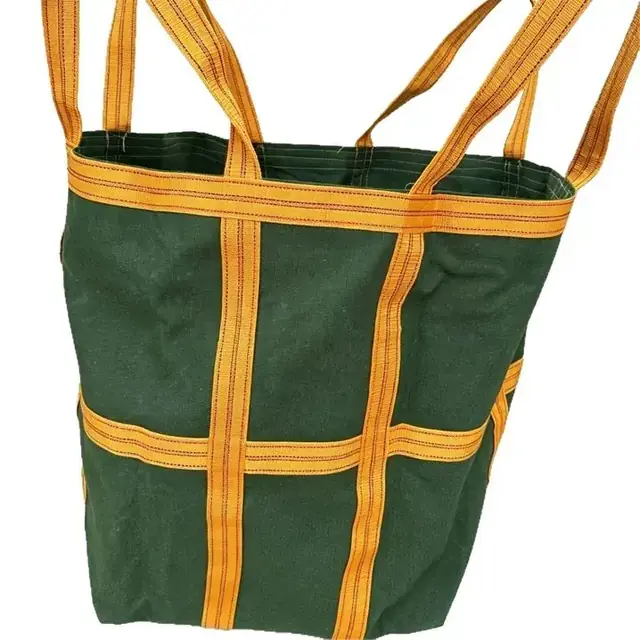
Four separate panels are sewn into a box with a separate base sheet. It is the simplest way to build a rectangular bag and gives even load distribution across four seams. It is widely used for construction and mineral loads where the bag is lifted by corner loops and emptied in one go.
State the product, the bulk density, whether the bag will be stacked (and to what height), and how it will be lifted and emptied. Those four answers usually determine the construction before price is mentioned. If you already have a bag that works, send a sample — matching an existing construction is faster and safer than designing from scratch.
Published 2026-10-12 · Last reviewed 2026-10-12
Tell us what you need — drawing, photo or just an idea. We reply with price, MOQ and sampling time.
For an accurate price, include: product & use · size or SWL · quantity per size · printing needs · destination port